Showing posts with label books. Show all posts

Friday, April 9, 2010

Book Review: Lolita


"You can always count on a murderer for a fancy prose style"

Book Details:

School & Library Binding: 336 pages

Publisher: Turtleback; 1st Vintage International Ed edition (April 1, 1997)
Language: English
ISBN-10: 0613706250

Review:

I have read enough reviews with cautious admissions that the reader enjoyed Nabokov's Lolita.  I am not going to be cautious.  I loved it!  Sure, it was not subject matter that I found particularly appealing, and our society does--and must, I think--hold pederasty in the highest contempt.  However, this was a fantastically written novel, and I think everyone should be required to read it.

I won't give away much of the plot through my review because I believe this is the first book on the list that everyone MUST read, and I am fairly certain that many people avoid it.  I initially wanted to read it before the arrival of the next baby, simply because I thought people would frown upon a newly delivered mother reading Lolita.  Surely, there is some stigma attatched to the book.

On the other hand, most people will gladly watch Law and Order: SVU or other incarnations of the series, all of which are significantly more explicit than Lolita.  There were no incredibly explicit scenes, no "pornography" or anything like it.  In fact, reducing Lolita to the pederasty is akin to describing a gourmet dinner of filet mignon to "beef and vegetables."  Nabokov's masterpiece is far too rich, nuanced, and developed to be painted with such a broad brush.

I could wax on and on about my thoughts on the book: the richly developed characters, the clever plot, the brilliant prose, but, suffice it to say, I thoroughly enjoyed Lolita.  It was the first book on the list that I have "loved," and I hope there are more like it.

Summary
Was this a good read?
You bet!  Fantastic!

Would I recommend it?
Without reservation.

Would I read it again?
And again, and again, and again.

Friday, April 2, 2010

Book Beginnings Friday: Lolita

Book Beginnings on Friday is a meme hosted by Becky at Page Turners. Anyone can participate; just share the opening sentence of your current read, making sure that you include the title and author so others know what you're reading. If you like, share with everyone why you do, or do not, like the sentence.

"Lolita, light of my life, fire of my loins."

This is probably one of the cheesiest opening lines, ever!  First of all, it doesn't tell me anything I don't already know from pop culture and the cover.  Secondly, it's all cliche.  There is nothing new or inventive about "...light of my life, fire of my loins."  These trite phrases can be found in just about any book, poem, or song lyric picked at random.

I already know that Nabokov is a master of prose, but this opening sentence is not his best...

Thursday, March 25, 2010

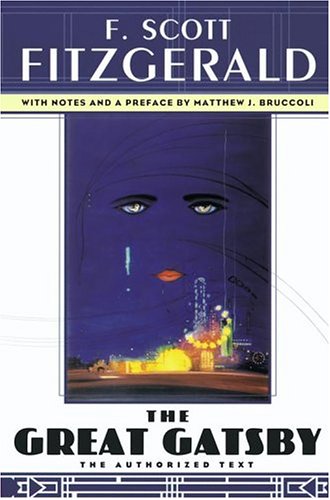
Book Review: The Great Gatsby


"Gatsby believed in the green light, the orgiastic future that year by year recedes before us.  It eluded us then, but that's no matter--tomorrow we will run faster, stretch out our arms farther... And one fine morning--
So we beat on, boats against the current, borne back ceaselessly into the past."

Book Details:
Paperback: 180 pages
Publisher: Scribner; ZZZ edition (September 30, 1999)
Language: English
ISBN-10: 0743273567

Review:

The Great Gatsby by F. Scott Fitzgerald is one of the classics of modern American literature for good reason.  Narrated by Nick Carraway, it details one summer in the lives of Tom and Daisy Buchannan and Jay Gatsby.  This short, quick read whose plot spans just one summer, encapsulates the modern American life.

The plot starts out slowly, detailing life as usual at the Buchannan and Gatsby residences.  Tom Buchannan keeps a mistress in the city, and Daisy, and everyone else, are well aware of this fact.  He does not seem too embarrassed about it, but Daisy is obviously unhappy with the arrangement.  Jay Gatsby, meanwhile, is Nick's wealthy and mysterious neighbor, fond of throwing large, bacchanalian parties every weekend.  Rumors as to his origin abound, but nothing is initially explained.

Through the course of the novel, it becomes apparent that Gatsby came from nowhere, acquired at least the appearance of wealth, and had a romance with Daisy prior to her marriage.  While he went off to World War I, she stayed home and eventually married Tom.  Gatsby has come to Long Island for the purpose of rekindling his relationship with Daisy, a goal which does not take him long to achieve.

Subsequently, Tom confronts Gatsby and Daisy, and the mysterious, possibly criminal, origins of Jay Gatsby are revealed in full.  In the aftermath, Daisy accidentally hits Tom's mistress with Gatsby's car, and the mistress' husband avenges his loss by murdering Gatsby.  Meanwhile, Tom and Daisy make amends and leave town for a while.  In the end, none of the avid party-goers attends Gatsby's funeral, not even Daisy.

After hundreds of pages of Joyce, The Great Gatsby was a breath of fresh air.  The precise language and well-developed plot were such a change that I managed to read Gatsby in one afternoon.  The novel was plot driven and thought-provoking, which made it difficult to notice the absence of puns and word play.  While Fitzgerald lacked the linguistic genius of Joyce, this was definitely a more enjoyable read.

The primary reason that this text endures, though, seems to be its take on the American Dream.  While innately depressing, I am sure that most of us suspect the novel holds a grain of truth.  Jay Gatsby worked his whole life to attain wealth so that he could have a relationship with Daisy.  He feted large groups of people, was generous to a fault, but he still did not quite fit into the elite social life of the Buchannans.  In fact, at his death, not even the woman whom he spent his life wooing came to mourn.  After years of hard, and possibly criminal, work, Jay Gatsby was left with nothing, "borne back ceaselessly into the past."

In addition, the following quote about Tom and Daisy seemed very poignant to me in this day and age:

They were careless people, Tom and Daisy--they smashed up things and creatures and then retreated back into their money or their vast carelessness, or whatever it was that kept them together, and let other people clean up the mess they had made..."

These are the people that we have slowly morphed into over the past century.  Gradually, people have been less and less willing to take responsibility for their actions, and our culture certainly encourages, if not commends, retreating into money and commercialism to avoid dealing with real life.  This novel is certainly a critique of modern American life, and a farsighted one at that.

Summary:

Was this a good read?
Absolutely!  An easy to follow, entertaining, thought-provoking read.  The plot was well developed, and the prose was crisp.  I loved it.

Would I recommend it?
Yes.  To anyone and everyone.

Would I read it again?
Certainly!

Friday, March 12, 2010

Book Beginnings Friday: The Great Gatsby

Book Beginnings on Friday is  a meme hosted by Becky at Page Turners. Anyone can participate; just share the opening sentence of your current read, making sure that you include the title and author so others know what you're reading. If you like, share with everyone why you do, or do not, like the sentence.

The Great Gatsby by F. Scott Fitzgerald

In my younger and more vulnerable years my father gave me some advice that I've been turning over in my mind ever since.

In my opinion, this is not a particularly good opening sentence.  It does make me curious as to what the advice is, and why it is pertinent; however, the rest of the first chapter is much more intruiging to me.

Wednesday, March 10, 2010

Book Review: Ulysses


"It has been an unusually fatiguing day, a chapter of accidents"
                                                                                            --Leopold Bloom

Book Details:
Paperback: 1040 pages

Publisher: Penguin Classics (March 30, 2000)
Language: English
ISBN-10: 0141182806

Review:

I have actually been dreading writing this review.  Trying to review a book that provokes such extreme and diverse opinions in thousands, if not millions, of people is a daunting task at best.  Especially since my opinion is a casual one at best.  That said, I'll give it my best shot.

The basic plot of Ulysses is exactly that: basic.  It primarily follows Leopold Bloom throughout the course of his waking hours on June 16, 1904.  We first see him before breakfast, and we last see him as he crawls into bed in the wee hours of the next morning.  While he runs errands, attends a funeral, attempts to work, frequents a few bars and a brothel, and walks home, we are subject to his thoughts, imaginings, and hallucinations.  If that seems like a fairly boring plot, I can attest to the fact that it is.

In addition to Bloom's travels, we encounter Stephen Dedalus several times.  In fact, Bloom's day is bookended by Stephen's own wandering.  I recall him fondly from high school literature class, but I will reserve most of my discussion of Stephen Dedalus for my review of Portrait of the Artist as a Young Man.

To my mind, Bloom is a fairly average man.  He spends a lot of time seemingly unaware of what is going on around him, and he is not particularly popular or successful at work.  His wife seems unfaithful at best, an unattractive hypochondriac at worst.  Bloom also appears to imagine or hallucinate when conversation is lacking or unstimulating.  Rather than actually participating in dialogue with friends, he appears to assume their response.  He is also lecherous from the first, trying to catch glimpses of stocking in the opening chapters and experiencing a hallucinatory visit to a brothel toward the end. 

What really struck me about Ulysses, though, was the sheer wordplay and brilliance of construction.  Each chapter, or section, is written in a different style, ranging from newspaper headlines to archaic Anglo-Saxon language to Socratic dialogue.  I am simply in awe that one man could execute the diverse structure of the novel so well.

And as I said, the wordplay is phenomenal.  True to form, Joyce uses neologisms throughout Ulysses with great success.  For instance, in the "Wandering Rocks" section, he mentions a gentleman struggling with a "stickumbrelladustcoat."   Reading that word instantly conjured a vivid picture of the man in question and how he was carrying his accessories.  There are passages such as the following that I just found amusing:

            What suddenly arrested his ingress?
The right temporal lobe of the hollow sphere of his cranium came into contact with a solid timber angle where, an infintesimal but sensible fraction of a second later, a painful sensation was located in consequence of antecendent sensations transmitted and registered.

Obviously, it would be tiring to read hundreds of pages in that raw, scientific style, but I thought it was a fantastic way to say that he bumped his head.  There are hundreds of other examples of Joyce's linguistic play, but since that was my primary joy in reading the novel, I won't spoil them all here.  (Not to mention the fact that I have better things to do!)

As far as the charges of indecency go, there are certainly sections of the novel that are downright pornographic.  In fact, there were parts that were very difficult for me to read, given their graphic nature.  The sections, as in "The Oxen and the Sun," where the men are sitting around being lewd did not particularly disturb me.  Neither did a lot of the graphic descriptions of bodily functions.  However, "Circe" was a tough chapter as I could not discern which sexual acts were actually happening, which were Bloom's fantasies, and which were his nightmares.  It was all jumbled together, and, as I say, downright pornographic.  Also, there is a section where a young girl exposes herself to Bloom as he masturbates that I found disturbing.  I suppose, though, I'll have to get over that issue soon since Nabokov's Lolita is just a few books away.

Summary:
Was this a good read?
That depends on what is important to you.  As a novel, it was not particularly great.  Average, but not great.  As a work of art, as a manuscript, it was phenomenal.  While the story was primarily boring, the linguistic talent used to write it is, to me, mindblowing.

Would I recommend it?
Certainly, with reservations.  If someone is a lover of literature and wordplay, particularly modernism, this is an amazing must-read.  If someone is looking for a quick, entertaining read, look elsewhere.  I do think that everyone who considers themselves a language lover should read this one, but I definitely do not think all of those people will love it.  There is simply not enough plot.

Would I read it again?
Absolutely!  I am going to be working on a side project, researching some of the issues and criticism surrounding Ulysses in the spare time I have between reading, blogging, crafting, and raising children.  Well, a girl can dream, right?

Tuesday, March 9, 2010

Chunkster Challenge 2010

Since setting my reading goal this year, I have been reading lots of book blogs.  It is almost better than a book club because I get tons of recommendations and reviews each day in addition to general book banter.  Most of the blogs I've been reading, though, are participating in the Chunkster Challenge this year. 

To qualify for the challenge, each book has to be 450 pages, and given my reading list, I'd say I would be stupid not to participate.  It is just one month into the time frame, and I have almost completed a 690 page chunkster.  On the list are several others that are weighing down my bookshelf as we speak!

In order to participate, I have to choose a participation level for the year.  As of today... eek... I am committing to read... wait for it... six large tomes this year.  I'm not sure that I'll necessarily complete it, but I'm a fan of setting big goals.  At least that way I will be motivated to read through the Modern Library List at a reasonable pace!

Wednesday, March 3, 2010

Ulysses: Who is Leopold Bloom?

At long last I have found a way to make it through Ulysses without feeling too incredibly lost.  Also, this method manages to keep me from unintentionally dozing during the slow, dull parts.  So what is my new magic trick?  Well, I grabbed a pen and a journal, and I have started taking notes as I read.  When I have a question, read one of the many good puns, or something just strikes my fancy, I'm jotting it down.  Hopefully, this new method (which I should have thought about during my college days) will enable me to finish Ulysses in the next week.  I'm ready to move on.

That said, one question that is fascinating me is the identity of Leopold Bloom.  He is ridiculed by so many characters.  He is always lurking unobtrusively in the background somewhere.  Apparently, one of those people you don't really notice, unless they have a moment of epic awkwardness. 

There are, however, indications that he might be a little more complex than my initial impression.  In the  Wandering Rocks several of the characters discuss him, saying that there is "a bit of the artist about old Bloom" and, "I'll say there is much kindness in the Jew." 

The last quotation is, in fact, a quote from Shakespeare's The Merchant of Venice , and I have been wondering about comparing Shylock to Bloom.  Seems like that would make for interesting reading, so I suppose I can find an article somewhere online along those lines.

Anyway, my goal is to finish this book up this week so that I can move on to Fitzgerald next week!

Friday, February 26, 2010

Ulysses: The Good and the Bad, so far.

Well, I am continuing to slog through Ulysses as we speak.  I am only a little over a third of the way through, but I am finding certain aspects of the book insanely boring.  On the other hand, there are elements that I find brilliant, and poor Nathan has to deal with my random Joyce quotations or theories on a nightly basis.

My primary challenge, it seems, is that I was going to ignore a lot of the scholarship when reading this list.  After all, I don't have time to read the entire list and all of the associated criticism.  Ulysses alone would consume my life.  Already, I am tempted to start research onto some of the multitude of themes, issues, and ideas in the novel.

There is a lot of discussion about Irish Home Rule, with major players appearing, theories espoused, and speeches quoted.  Although I know next to nothing about the issue, this is one of the most fascinating aspects of the book, and I am thoroughly tempted to venture beyond Wiki research into detailed, authenticated discussion of Ireland at the turn of the previous century.

The last episode I read, too, was a challenge because it had me reaching for the Shakespeare anthology and absolutely dying for comrades to discuss the mystery surrounding Shakespeare's identity, Anne Hathaway, and such.  It is the "Scylla and Charybdis" episode, and it takes place inside the National Library.  Stephan Dedalus is expounding upon an essay he has written regarding the Bard, and I was riveted. 

Which brings me to my primary issue with Ulysses.  As a novel, it is somewhat less than fulfilling.  As a work of social commentary and literary criticism, it is invaluable.  The puns and allusions are fantastic.  The turn of phrase is brilliant.  The stream of consciousness is skillfully executed.  But the plot is duller than anything I've read in a long time.

Leopold Bloom is, thus far, a boring loser.  And that is putting it politely.  It appears he is lousy at his job, his boss, co-workers, and supposed friends tend to ignore him, and, from all appearances, his wife is having an affair.  Having to read a day's worth of his thoughts is torture.  I suppose we're all like this, but, boy, does it make for a lame read.  If you're reading a novel primarily for plot, this is not the work for you!

That said, I am planning to finish Ulysses soon.  I need to put down some of the crafts and pick up the novel.  Hopefully, Bloom will not continue to disappoint.

Wednesday, February 17, 2010

Ulysses: What's the Fuss?

When I decided to read the 100 Best Novels, I simultaneously decided to start at the top of the list and work my way down.  Initially, I was going to read both the Editors' and Readers' lists simultaneously, but I have changed my mind after starting with Ulysses by James Joyce.  I am going to focus on the Editors' list and move to the Reader's list upon completion.

Why the shift?

Well, I am really enjoying (yes, you read that correctly) Ulysses. 

Throughout high school and college, I had heard many people disparage Ulysses.  "Yes," everyone said, "You think you like Joyce, but that is until you read Finnegan's Wake and Ulysses.  You'll change your mind after those."  As a consequence, I never started reading either one.  And, to be completely truthful, the library's copy of Ulysses has been sitting on my bedside table for about two weeks now, and I just got the courage to open it.  Talk about an intimidating book.

What a letdown!  After all the drama, I expected the book to be incomprehensible, terrible, and way over my head.  BAH!

Granted, I have only read Part 1, dealing with Stephen Dedalus.  There is a lot of novel left, and it may get increasingly difficult as it progresses.  So far, however, it is just the rambling internal monologue of Dedalus as he goes through the day.  Yes, there are a lot of allusions, but that is not entirely unexpected in literature.  Yes, it is stream of consciousness, but this is a girl that digs it.  No, there is not a lot of action, but you don't always need a  lot of action.

At this point, it seems as though Dedalus is consumed with guilt over his mother's death, and much of the interior monologue deals with his mommy issues.  There is other guilt, as well, however.  From my impressions, there is a lot of Catholic guilt--a phenomenon I seem to vaguely recall from Portrait of the Artist and Dubliners. 

In any event, I am actually enjoying what many have called the "worst best book" on the list.  I can't wait to get further and see if my initial impressions change.

And, I am too excited about other novels on the Editor's list to worry about reading Battlefield Earth and  The Fountainhead.  Both probably deserve a read, but I am putting them at the bottom of a hundred other books!

Tuesday, February 9, 2010

I'm Booking It in 2010: To Kill A Mockingbird


As I stated last week, I'm on a mission to read the 100 Best Novels over the next few... well... years.  So when I saw this link-up at Life As Mom, I knew I had to link up.  In case you're wondering, I just love linking posts up to something!

Last month, I actually read one of the books on the list: To Kill a Mockingbird by Harper Lee.  Somehow, I was the only kid in America who didn't read the book in middle school or high school.  In fact, last month was the first time I'd read the book, and, boy, was it good.

Obviously, the racial themes have been well documented, and, in fact, I was expecting a little more about segregation and the racial divide in the South than the book contained.  Perhaps my view is skewed, though, because I was on a Toni Morrison-Alice Walker kick a few months ago.  Regardless, I didn't think that racism, per se, was the primary point of the novel.

What struck me most was the prevalence of the mockingbird motif throughout the entire novel.  From Tom Robinson, the black man Atticus Finch defends, to Boo Radley, the recluse that Scout and Jem torment, the constant theme appears to be that it would be cruel to kill something that is innocent and harmless.  For that reason, Atticus defends Tom Robinson, and for that reason, the sherrif chooses to keep the true story of Scout and Jem's rescue by Boo Radley secret.  Ruining innocence is the chief crime in Lee's universe.

Anyway, my favorite character was definitely Dill, who inspired Scout and Jem to endless hours of summer fun.  A minor character, Dill was nonetheless entertaining, and he provided some comic relief at times when the novel's events got intense.  Besides, I later found out that his character was based on Truman Capote, who was a childhood friend of Harper Lee.  WOW!

These are just some quick thoughts on the novel.  I could continue for hours and paragraphs, but I figure this isn't the forum for that...

Friday, February 5, 2010

Reading Plan:100 Best Novels

Somehow, even though I belong to two book clubs, I find myself at a loss for something to read.  I browse the library and usually end up with some interesting stuff.  Unfortunately, though, it feels like I'm "eating" a diet of candy, and not too many vegetables.  My mind is craving some sustenance!

After browsing several book lists looking for ideas, I stumbled upon a Random House list of the 100 Best Novels.  Overall, it seems like a good list, so I have decided to read both lists in their entirety.  There are some repeats from the Board's List and the Reader's List, so I won't end up reading 200 books, but even so, it should take me some time to complete my personal assignment. 

To get started, I checked out the first five titles on each list from the local library.  Now, I just need to find the time to read them.  I plan on reviewing the books, or at least formulating some thoughts about each on the blog as I finish them.

What does anyone else do for book ideas?

Friday, January 29, 2010

Book Review: Sophie-Safe Cooking

For my birthday, my sister gave me a copy of Sophie-Safe Cooking by Emily Hendrix. It is full of recipes free of all of the eight major allergens: milk, eggs, wheat, soy, peanuts, tree nuts, fish and shellfish. Needless to say, this book is one of the best additions to my kitchen in the past year.

Unlike most books that cater to the allergy-friendly community, this one uses common household ingredients to make a wide range of baked goods, breakfast foods, dinners, and delicious desserts! (Can you tell which section I've been playing with?!) Each recipe is also easily customizable for a particular set of eating restrictions. For example, if dairy is not an issue, you can use milk and butter. If wheat is not an issue, you can use wheat flour. And so on.

The primary ingredients in a lot of the recipes are oat flour and Spectrum shortening. For some reason, these were major eye-openers to me.

For one thing, oat flour doesn't require xanthan or guar gum to yield respectable looking baked goods. For another, it is easy enough to grind your own in a food processor or blender from oats. Instead of paying $2.39/lb of brown rice flour, I can now pay $0.88/lb for organic oats. It sounded like it might be a lot of work to grind the oats, but it took me less than 15 minutes to grind 10 lbs yesterday.

And the shortening? Amazing! Spectrum uses cold-pressed palm oil for their shortening, so it is dairy, soy, and trans-fat free! Hooray! I now have a way to make pastries, cookies, and frostings that actually taste delicious.

There are many other nuggets of information in the book, and on her website www.sophiesafecooking.com All of the recipes are cheap, easy, and, most importantly, delicious!

Friday, January 15, 2010

My Philosophy...

The following is quoted from Steinbeck's East of Eden and seems to sum up my philosophy on life:

I don't know how it will be in the years to come. There are monstrous changes taking place in the world, forces shaping a future whose face we do not know. Some of these forces seem evil to us, perhaps not in themselves but because their tendency is to eliminate other things we hold good. It is true that two men can lift a bigger stone than one man. A group can build automobiles quicker and better than one man, and bread from a huge factory is cheaper and more uniform. When our food and clothing and housing are all born in the complication of mass production, mass method is bound to get into our thinking and to eliminate all other thinking. In our time mass or collective production has entered our economics, our politics, and even our religion, so that some nations have substituted the idea collective for the idea God. This in my time is the danger. There is great tension in the world, tension toward a breaking point, and men are unhappy and confused.

At such a time it seems natural and good to me to ask myself these questions. What do I believe in? What must I fight for and what must I fight against?

Our species is the only creative species, and it has only one creative instrument, the individual mind and spirit of a man. Nothing was ever created by two men. There are no good collaborations, whether in music, in art, in poetry, in mathematics, in philosophy. Once the miracle of creation has taken place, the group can build and extend it, but the group never invents anything. The preciousness lies in the lonely mind of a man.

And now the forces marshaled around the concept of the group have declared a war of extermination on that preciousness, the mind of man. By disparagement, by starvation, by repressions, forced direction, and the stunning hammerblows of conditioning, the free, roving mind is being pursued, roped, blunted, drugged. It is a sad suicidal course our species seems to have taken.

And this I believe: that the free, exploring mind of the individual human is the most valuable thing in the world. And this I would fight for: the freedom of the mind to take any direction it wishes, undirected. And this I must fight against: any idea, religion, or government which limits or destroys the individual. This is what I am and what I am about. I can understand why a system built on a pattern must try to destroy the free mind, for that is one thing which can by inspection destroy such a system. Surely I can understand this, and I hate it and I will fight against it to preserve the one thing that separates us from the uncreative beasts. If the glory can be killed, we are lost.

Thursday, January 14, 2010

Birthday Present!

My birthday is on Tuesday, and I can't wait to complete yet another year. Boy, am I getting ancient, or what?! Anyway, my mom and dad gave me a copy of Alison Stewart-Guinee's Fairy Tale Knits, which I have been ogling online and in bookstores since early December. It is a fantastic book, filled with gorgeous patterns that I, and hopefully my kids, will love!

When the book arrived, I gave it to Adrienne so that she could help me choose a project to complete (given that she is the one who has to wear what I'm making!) and she instantly fell in love with the fairy sun dress, pictured here on flickr. I'm not crazy about the length of the "leaves" at the bottom of the skirt, so I may lengthen them, but I am not sure at this point.

In any event, I rushed online to buy my yarn so that I can get started ASAP! I will post pictures of the finished product here when I'm done.

In the mean time, please check out Alison Stewart-Guinee's blog, which I was excited to find this afternoon. She has tons of other craft ideas, both yarn, fabric, and miscellaneous other crafts.

Tuesday, August 25, 2009

Book Review!


I just finished reading Barbara Kingsolver's Animal, Vegetable, Mineral this week. It chronicles her family's decision to eat only locally produced food for one year. Instead of heading to the grocery store each week, the family grows their own vegetables, slaughters their own poultry, and frequents the farmer's market. Thanks to freezing, drying and canning produce at harvest time, the family is able to live out the winter on the literal fruits of their labor.

While this isn't the first book I've read along these lines, I did enjoy it. As always, Kingsolver is an excellent writer, and her prose is effortless to read. She includes numerous details about family and farm life that had me rolling on the floor with laughter. For example, her youngest daughter sees the jonquils blooming in the yard and calls them "tranquils."

The passages that kept me glued to this book, though, were the ones about modern farming techniques: the patenting of seeds, the removal of seeds from circulation, the genetic modification of turkeys to prevent breeding, and the poor regulatory controls of commercial beef. If I hadn't already made the choice to eat only grass-fed cattle, pork, and poultry, this book would have caused me to make some major changes. As it is, it was just confirmation that my instincts regarding feeding my family are correct!

As far as detractions go, there were relatively few in this book. I don't think Kingsolver addressed the nutritional aspect of local eating adequately, but her audience may not be aware of (or interested in) the way the USDA has "bought" dietary guidelines in this country. She did get a little preachy on her politics in the book, too, and I thought it would have been better had she left that out. Unfortunately, she is the successful writer, and I am the chick who can't update her blog frequently enough!

Overall score: A